“We design, customise, build, and maintain HPC cluster systems for users, providing unified management of simulation data, flexible configuration of pooled resources, and integrating GPU remote 3D visualisation components to achieve efficient and stable operation, on-demand scheduling, and effective management of HPC clusters. This helps manufacturing enterprises efficiently and cost-effectively meet their engineering simulation and design needs.”
——ClusterTech Joint Partner, Hongyan Fu
Introduction
In the midst of a massive industrial transformation, the integration of industry and the internet is accelerating, and "Made in China" is moving towards "Intelligent Manufacturing in China", upgrading to high-end manufacturing, requiring innovative products with high added value and high technological content.
As "Made in China" moves towards Industry 4.0, High-Performance Computing has expanded from scientific research to enterprise and commercial applications, playing a strong catalytic role in innovation for the manufacturing industry. It can help manufacturing enterprises complete accurate and reliable simulation and analysis processes, promote innovation in enterprises, and even drive innovation in the entire industrial manufacturing industry.
On April 15th, ClusterTech, along with experts from Dell Technologies and Intel Corporation, jointly explored and interpreted the new trends and new value of High-Performance Computing in the field of intelligent manufacturing online.
The speech transcript of this live broadcast is compiled for your reference and learning. The following is the original text:
Good afternoon, distinguished guests. I am Hongyan Fu from ClusterTech. Welcome to the customer event jointly hosted by ClusterTech and Dell.
The topic of my sharing is "ClusterTech's Enterprise High-Performance Computing Solutions: Deciphering the New Value of HPC in Manufacturing".
The value of High-Performance Computing in the intelligent manufacturing industry
In the manufacturing industry, the simulation design process is usually divided into three parts:
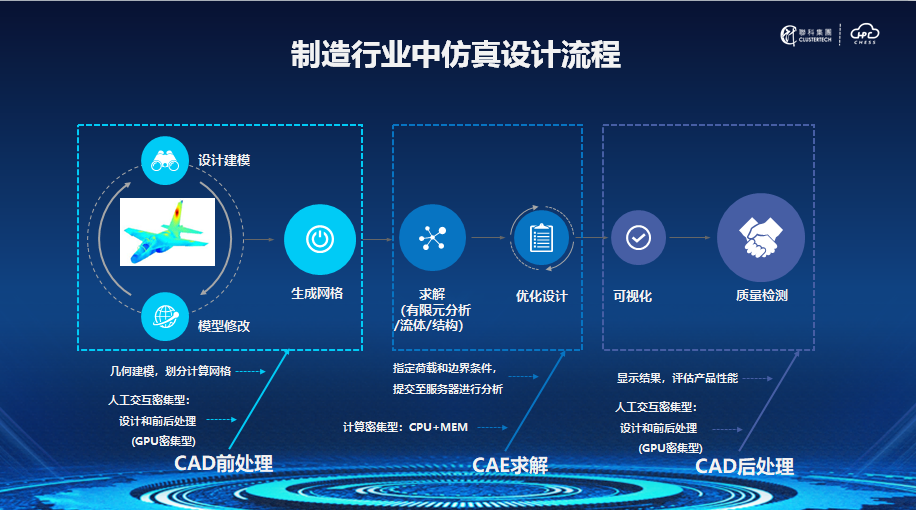
CAD pre-processing, which mainly uses GPUs for 3D modelling;
CAE solving and computing, which requires a large amount of CPU and memory resources and needs to be supported by a High-Performance Computing platform;
CAD post-processing, which is used to verify whether the computing results meet the requirements.
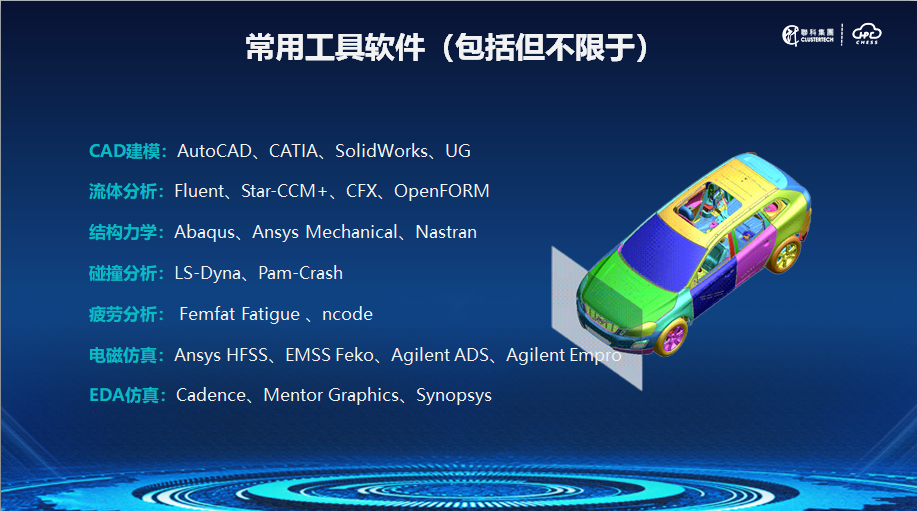
Common application software includes 3D modelling, fluid analysis, structural mechanics, collision analysis, and more.
What is the value of High-Performance Computing?
High-Performance Computing can reduce computation time, lower costs, and increase scale to improve efficiency.
By improving both speed and scale, High-Performance Computing can enhance enterprise efficiency and accelerate scientific research.
Therefore, many enterprises are now constructing HPC clusters to promote production and research and development.
However, many problems may arise during the construction and use of HPC clusters.
These problems can be summarised into two main categories: how to purchase a good cluster and how to use it effectively.
From an IT engineer's perspective, how to integrate different CAE software into business scenarios for planning and design, how to build a reliable application cluster system, how to ensure software and hardware performance are optimal, how to effectively manage and use HPC clusters, and how to ensure continuous optimal performance of the cluster.
From a CAE engineer's perspective, how to quickly conduct simulation design with limited experience in cluster use, how to better integrate with application software for easy job submission, and how to quickly process data and use the cluster when not familiar with Linux operating systems.
These are the difficulties that users face.
The value of using HPC in CAE simulation includes the following aspects:
HPC can solve more and complex problems
For example, some models require a larger simulation grid to achieve higher accuracy in simulating more detailed aspects. HPC can also simulate an entire machine, which goes beyond single-component simulations.
HPC can accelerate the research and development process
HPC clusters have strong processing power and fast computing speeds, which can quickly complete a large number of computing tasks, thereby improving design quality and efficiency.
HPC can lower investment costs
Performing simulations can reduce the number of physical experiments and associated costs. For example, in the manufacturing of an airplane or the design of a car's exterior, it is not feasible to create multiple physical models for testing due to the long cycle time and high cost.
HPC can improve the efficiency of research and development (R&D) design personnel
If the number of experiments is reduced and the experimental time is shortened, the efficiency of research and development design will naturally improve, and the cost will also decrease.
Centralised management of resources and improved utilisation rates are advantages of HPC, as it avoids the scattered and dispersed use of resources. Centralised deployment of software also reduces operational costs.
HPC can enhance a company's competitiveness
Using an HPC cluster for simulation design can shorten a company's product time-to-market, enabling faster launch of new products and quicker capture of market share.
HPC from ClusterTech can provide many solutions
ClusterTech's engineering simulation and design solution is based on ClusterTech's independently developed CHESS High-Performance Computing management platform and more than 20 years of industry experience. It is designed to provide users with customised HPC cluster system design, construction, and operation services, while unifying the management of simulation data and flexibly configuring resource pools. The solution also integrates GPU remote 3D visualisation components to achieve high-efficiency and stable operation of the HPC cluster, on-demand scheduling, and effective management, helping manufacturing enterprises efficiently and cost-effectively meet their engineering simulation and design needs.
The idea behind ClusterTech's manufacturing industry HPC solution is centered around applications, with hardware and software as the foundation.
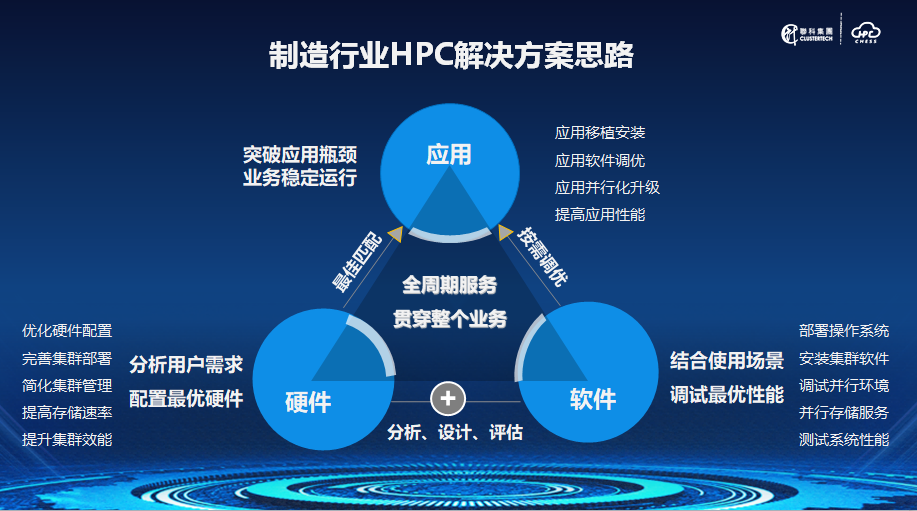
On the hardware side, HPC analyses user needs, designs, and constructs the optimal solution for the user's specific scenario, achieving the best possible match between the application and hardware.
On the software side, HPC optimises software usage according to the specific scenario, achieving the best possible performance for the entire cluster system and application software. HPC also provides an operation process that is in line with user habits and preferences.
On the application side, HPC provides a reliable, stable, and high-performance software and hardware platform, to achieve the best possible performance for application software.
In the entire HPC architecture, the most important aspect is the performance of application software. All software and hardware components should serve the application, with the aim of improving application efficiency.
ClusterTech's manufacturing industry HPC solution has the following advantages:
The first advantage is that ClusterTech has been focusing on High-Performance Computing for more than 20 years and has delivered thousands of projects. Therefore, we can truly focus on applications as the core and deeply integrate with the user's business logic.
The second advantage is that ClusterTech provides solutions from the system layer to the application layer, helping users solve the problems of purchasing and effectively utilising a cluster.
The third advantage is that optimising the traditional cluster construction approach, fine-tuning the configuration of software and hardware as needed to ensure optimal application performance.
The fourth advantage is providing a domestically developed cluster management platform, ensuring information security.
The fifth advantage is that ClusterTech efficiently integrates with many ecosystem partners, provides cross-platform technical integration for multiple businesses, and ultimately achieves accurate matching of complex user demands.
The sixth advantage is that ClusterTech provides services throughout the entire business cycle and has accumulated an HPC expert team, which can provide strong support for cluster construction and operation for users.
ClusterTech's manufacturing industry HPC solution consists of four parts, including the entire process of design, construction, and operation, as well as achieving optimal application performance through services.
Solution design:
In the solution design phase, we follow the principles of high reliability, usability, universality, data security, and visualisation. We analyse user requirements and design the optimal solution based on these requirements, including cost evaluation. If users have specific demands, we can provide POC verification tests and finalise the solution after confirmation with the user.
Here, we have drawn a typical HPC architecture diagram, and we will use this diagram to explain the solution design process.
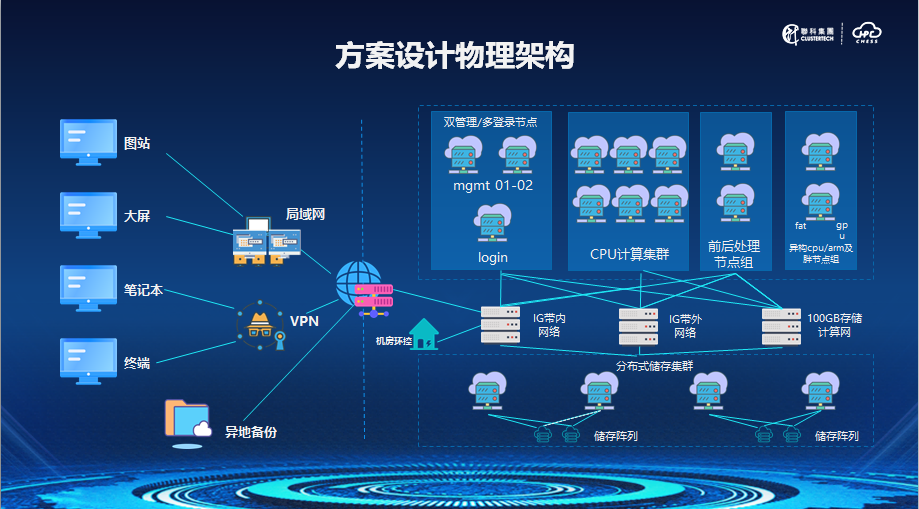
The nodes in the upper right corner are also a core component of HPC, determining the overall performance of the HPC cluster. Therefore, the selection of node CPUs and memory configuration are particularly important.
We choose the appropriate CPU or GPU card based on the user's actual scenario, whether it is from Intel, AMD, or other vendors.
If we choose an Intel processor, we also need to consider the specific model.
Next, we need to consider the network, which connects all the components of the cluster. We need to select the appropriate network architecture based on the specific usage scenarios, such as whether to use 10 Gigabit Ethernet, InfiniBand (IB), or Omni-Path Architecture (OPA).
Regarding storage, we need to select the appropriate storage architecture and parallel file system based on the specific requirements of the user's applications.
In addition, there are both open-source and commercial versions of software available for the HPC cluster, and the choice between them depends on the specific requirements of the user's applications. The HPC cluster can be configured with either Windows or Linux operating systems.
In the manufacturing industry, we often encounter scenarios where remote 3D visualisation is required. These are factors that need to be considered in the solution design process.
Cluster construction:
We have accumulated many years of experience in the HPC field, and we have several experienced engineers who have built and maintained many HPC clusters. We have also built up a large knowledge base, software library, and problem database, which enable us to provide reliable and efficient HPC cluster construction services.
Cluster construction is a major part of the HPC cluster deployment process, which includes hardware deployment, operating system deployment, and cluster software installation. After the HPC cluster system is built, we will optimise the performance of the entire system and install, debug, and optimise the applications while ensuring the normal performance of the HPC cluster. Finally, we will provide the user with documentation and training.
Specifically, HPC cluster construction includes two aspects: hardware and software:
Hardware deployment includes rack mounting, cabling, and power testing of all hardware components.
Software deployment includes the following steps:
First, install the system software, including the operating system, management software, file system, drivers, and database.
Next, install job scheduling software, such as our in-house product CHESS, as well as IBM LSF, open-source Slurm, and PBS.
Then, install the application software and integrate it with the entire platform.
It is important to note that the IO performance of the parallel file system can be a bottleneck in the HPC cluster, so we ensure the performance of IO during the construction process. Therefore, we offer installation and service for the three commonly used parallel file systems: BeeGFS, Lustre, and GPFS.
During the HPC construction process, the performance of the entire system and applications should be tested, evaluated, and optimised.
Firstly, the hardware performance testing is conducted to diagnose whether there is any hardware failure, including single-node/whole-cluster Linpack, memory bandwidth, IO, and network performance testing.
After ensuring the hardware performance is optimal, we will install and debug the application software, provide users with application analysis, testing, and optimisation reports.
During the delivery phase, we will also provide training for administrators and users.
Finally, we will provide delivery documents, including administrator and user manuals, testing reports, and implementation reports.
Cluster operation and maintenance:
The HPC cluster is a complex and large-scale system. It is an organic whole, and the reliability of the cluster depends on the normal operation and coordination of each device. Any failure in any link may cause huge losses. Therefore, the management of the entire HPC system is becoming increasingly important and challenging.
ClusterTech’s HPC cluster operation solution is based on the CHESS high-performance computing cluster management platform, which establishes a comprehensive and perfect HPC management and operation system based on the principles of advanced, practical, stable, reliable, and comprehensive. It monitors the real-time operation of the entire cluster's hardware and software, and quickly locates and handles faults.
It simplifies the maintenance work of the IT center cluster and improves the efficiency of software applications in business departments.
It provides functions such as reports to help management personnel make decisions on cluster expansion or upgrading, and provides comprehensive HPC operation and maintenance services.
In terms of after-sales service, we help users troubleshoot hardware, operating systems, file systems, job scheduling systems, monitoring software, and application software faults.
We also provide system inspection services to ensure the continuous, stable, and efficient operation of the cluster system.
Optimisation of the system and applications:
What is most important and concerned in building an HPC cluster is undoubtedly performance.
The main factors that affect performance include CPU, memory, network, I/O, and compilation or runtime parameters.
Therefore, it is crucial to assist users in conducting performance bottleneck analysis and optimisation for their applications during the implementation process.
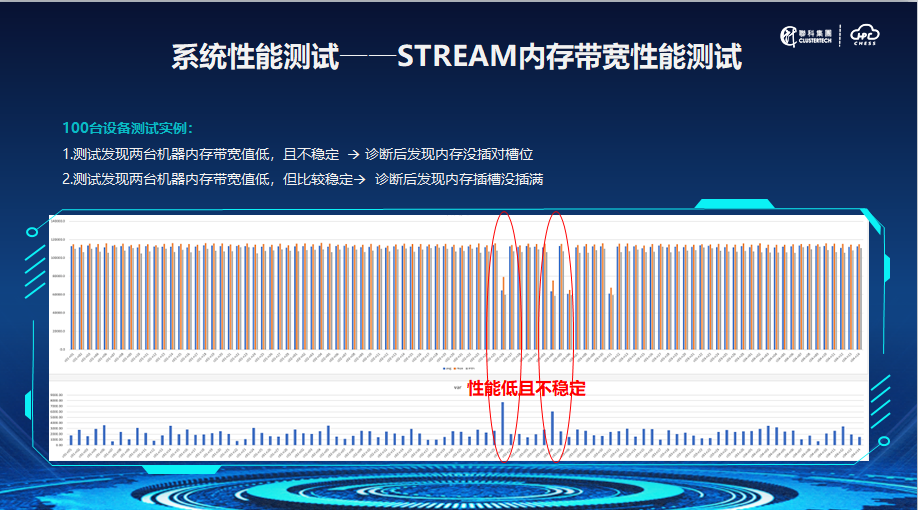
This is an example of memory bandwidth testing, where we tested the memory bandwidth of 100 machines and found that four of them had slightly lower memory bandwidth. Among them, two machines consistently showed low memory bandwidth in every test, while the other two machines showed unstable memory bandwidth, sometimes high and sometimes low.
After diagnosis, we found that the machines with consistently low memory bandwidth actually had memory slots that were not fully inserted, while the machines with unstable and low memory bandwidth had memory modules that were not inserted correctly. After making some adjustments, the memory bandwidth of the entire cluster reached a more balanced level.
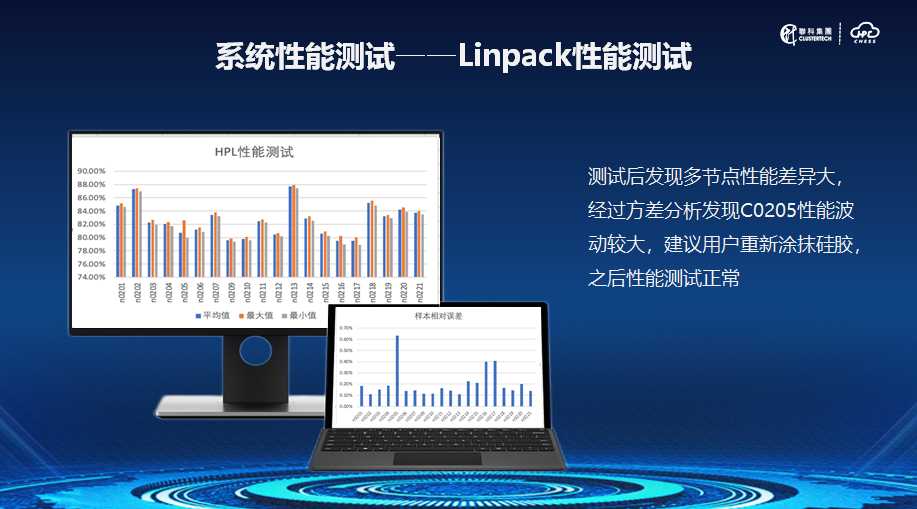
This is an example of CPU performance testing. After a period of usage, we performed a performance test during a routine inspection of the user's cluster and found that machine C0205 consistently showed high variance in multiple tests.
After various analyses and diagnoses, we recommended that the user apply thermal paste to the CPU. After applying the thermal paste, the performance of the entire cluster returned to normal.
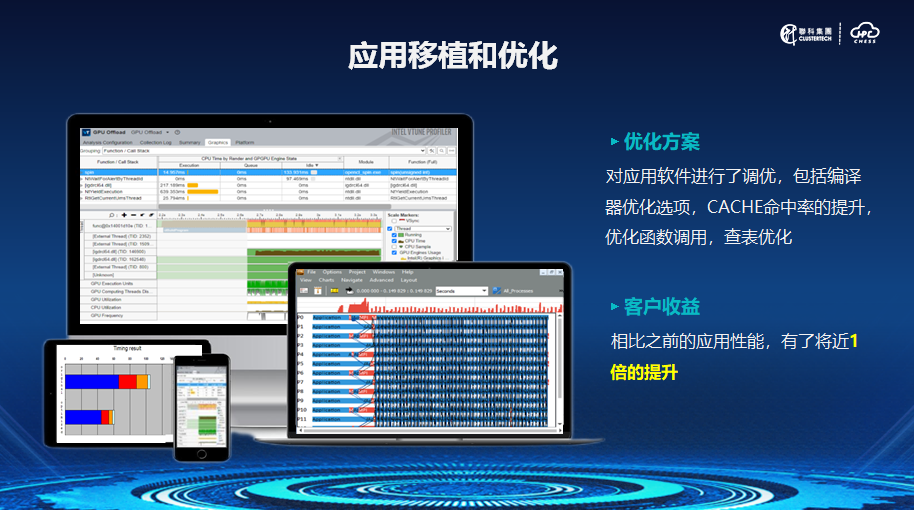
This is a case of application porting and optimisation. This is an application related to meteorology, and we optimised the application software, including compiler optimisation, improving CACHE hit rate, function optimisation, and table lookup optimisation. As a result, the application performance was improved by a factor of two for the user.
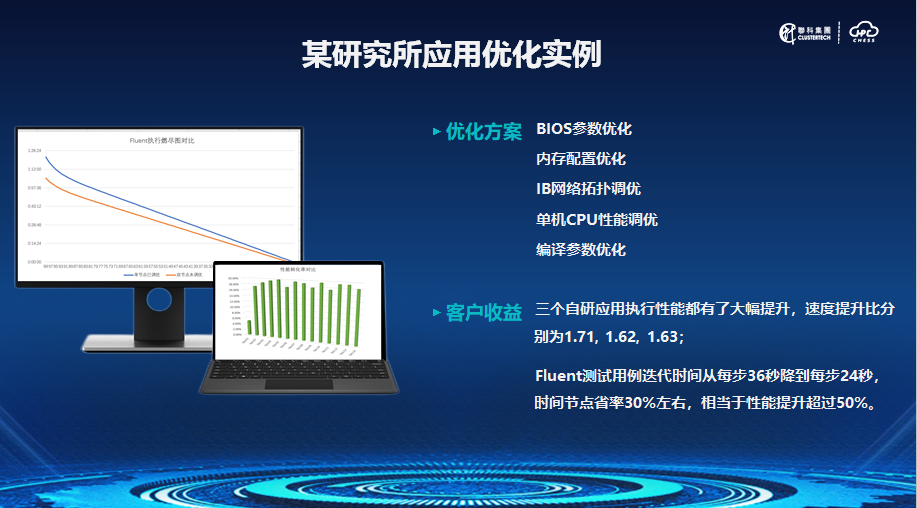
This is an example of application optimisation for a research institute.
The main points of optimisation included BIOS parameter optimisation, memory configuration optimisation, IB network topology adjustment, single-machine performance optimisation, and compilation parameter optimisation.
As a result, the performance of three self-developed applications of the user was significantly improved, with speedups of 1.71x, 1.62x, and 1.63x, respectively.
For Fluent testing, the computation time for each step was reduced from 36 seconds to 24 seconds, which corresponds to a 50% performance improvement.
Core products of the solution
The core product we offer is the CHESS High-Performance Computing Management Platform, which is a cluster management software developed by ClusterTech.
The CHESS High-Performance Computing Management Platform (ClusterTechHPC Environment Software Stack) is a high-performance cluster software developed by ClusterTech. It adopts a B/S architecture and is operated through a browser to achieve unified deployment, management, scheduling, monitoring, alerting, reporting, and billing of cluster resources. It can turn locally loose-stacked servers into a complete HPC cluster system. When local resources are insufficient, it can also call public cloud resources to significantly improve cluster efficiency, simplify cluster management, and operation. Since the release of the first version in 2001, CHESS has gone through more than 20 years of development and recently released version 6.6.
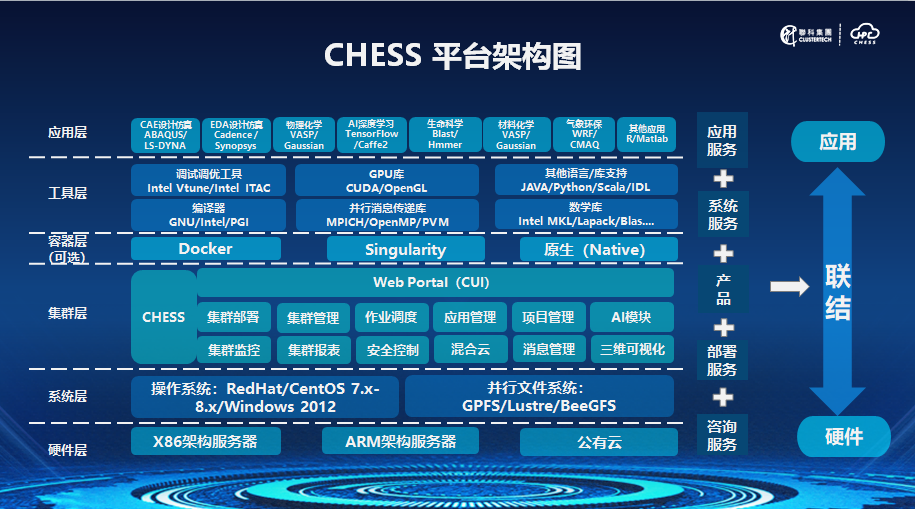
This is the architecture diagram of CHESS.
At the bottom layer is the hardware layer, which supports X86 servers, ARM servers, and public cloud resources.
Above that is the system layer, which supports the RedHat and CentOS 7.0-8.0 operating systems and Windows 2012. Parallel file systems supported include GPFS, Lustre, and BGFS.
Above that is the cluster layer, which is the functional layer of CHESS. CHESS provides cluster deployment, management, monitoring, scheduling, reporting, billing, project management, hybrid cloud management, application management, and more.
Above that is an optional container layer. If your application is packaged in a container, CHESS can use a container to run it. If the user's application is directly installed on the operating system, the container layer can be omitted.
Above that is the tool layer, which includes compilers, math libraries, debugging, optimisation, and other tools.
At the top is the application layer. In theory, CHESS can support any application software that runs on an operating system.
For more than 20 years, ClusterTech has mainly focused on running application software from various industries on hardware platforms at the bottom layer, and ensuring good performance.
The CHESS Web Portal is the access portal for CHESS. Users can log in with their own username and password, and can see the functions and accessible application software assigned by the administrator after logging in. Each application is represented by an icon, and parameters can be customised according to the user's usage habits, making it easy for users to submit jobs to the cluster quickly and easily.
The CHESS security control module is mainly used in military industry scenarios that require confidentiality certification and provides functions such as three-member management, project management, and security level management. The three members include system administrators, security officers, and auditors.
The CHESS scheduling system is the most critical software feature in the cluster. The configuration and optimisation of scheduling strategies directly affect the efficiency of cluster usage. CHESS supports multiple schedulers such as LSF, Slurm, and PBS, and corresponding scheduling algorithms such as reservation, preemption, and fair sharing. CHESS also supports GPU scheduling, including scheduling for single-machine single-card, single-machine multi-card, and multi-machine multi-card GPUs, as well as scheduling for artificial intelligence frameworks.
CHESS provides user management functions, allowing users to create their own users in the CHESS cluster, or interface with existing LDAP or AD accounts in the enterprise, or import enterprise organizational structure for management.
CHESS supports sub-administrator functionality, as system administrators may not always be familiar with the internal usage of departments or projects. This allows for more granular user and job management to be delegated to sub-administrators. CHESS also supports permission and role management and customisation.
The application management feature in CHESS allows administrators to create interactive application templates based on user habits using system-provided components.
These templates can be assigned access permissions, and users can view the input and output of the application during execution, as well as CPU and memory usage. Users can adjust interactive parameters in real-time during application execution.
CHESS includes data management features, allowing users to manage files without needing to know Linux commands. Users can upload, download, compress, decompress, copy, and perform other file management functions with a mouse.
CHESS's resource management feature enables administrators to manage CPU, GPU, and hybrid cloud nodes in the cluster. In the node management module, users can view CPU and memory usage, job distribution, and node load status. This feature can help diagnose problems with abnormal CPU or memory usage and identify jobs that were not submitted through the scheduling system.
CHESS also supports resource limitations, allowing administrators to manage resources for departments or project groups. For example, administrators can set the maximum number of CPU cores or the number of concurrent jobs for each department.
The monitoring module in CHESS provides real-time monitoring of CPU, memory, network, and disk usage on individual machines or the entire cluster. The platform also provides a cabinet diagram that displays the physical location and status of each machine. Using this feature, users can remotely power on or off machines, access command-line or graphical terminals, and perform other operations.
CHESS's billing system supports account recharge, discounts, and overdrafts. Administrators can set the total amount of resources available to users or departments and provide different discount rates for different users or departments. Users can view detailed billing information for each job, including start and end times, total CPU hours, and pricing for CPU, memory, and storage. The platform also supports billing reports for tracking total expenses for users or departments over a specific time period.
CHESS also provides cluster reporting, including job information and machine resource usage reports. Users can view job statistics based on user, department, queue, and project dimensions, including total jobs, total CPU hours, and average queue time. The platform also provides machine resource usage reports for CPU, GPU, memory, and storage.
The license management feature in CHESS provides license management, monitoring, scheduling, reporting, and billing for application software licenses. The platform also provides warnings for expiring licenses and allows administrators to set rates for licenses from different vendors or features. Users can view the usage status and service status of each license.
The workflow management feature in CHESS allows users to create a task flow with dependencies by dragging and dropping application templates. Users can customise the dependencies within the application template and monitor the progress of the entire workflow, including the status of each sub-task.
CHESS also supports message management, enabling administrators to post announcements on the homepage or send messages to specific users or user groups. Users can view administrator announcements and job information, including job start and end times, error messages, and billing information.
CHESS supports scheduling for Caffe, TensorFlow, and other AI frameworks, as well as GPU scheduling for single-machine single-card, single-machine multi-card, and multi-machine multi-card configurations.
CHESS also supports hybrid cloud scheduling with public cloud providers like Alibaba Cloud, Tencent Cloud, and Huawei Cloud, allowing for task scheduling on public clouds when local resources are insufficient.
There are several advantages of CHESS:
The first one, as just mentioned, is the support for hybrid cloud functionality. When local resources are insufficient, we can directly call computing resources from public clouds or supercomputing centers.
The second one, CHESS supports private cluster management, including fast deployment, centralised management, and intelligent scheduling.
The third one, CHESS supports GPU monitoring and scheduling, supporting single-machine single-card, single-machine multi-card, and multi-machine multi-card scheduling.
The fourth one, CHESS supports multiple architectures, such as X86 and ARM architectures, supporting Linux, AIX, and Windows mixed clusters.
Fifth, it supports multiple AI frameworks, such as TensorFlow and Caffe.
Sixth, it supports multiple containers, such as Docker and Singularity.
Success Stories
The first case is the Beijing Research Institute of Ansteel, which mainly researches steel structures and materials. CHESS was used to build a cluster system that can run applications such as Fluent, Ansys, and VASP.
With this cluster system, users can easily manage and use the cluster, improving the efficiency of applications.
The second case is Shanghai Pan-Intelligence Energy.
The user originally used workstations for computing, but later adopted an HPC cluster for simulation design. The user purchased three phases of Dell hardware devices, all managed using CHESS, mainly using software such as Abaqus, Numeca, Ansys, Fluent, and CFX.
Previously, it took forty-eight hours for a user to run a job on their original workstation, which means that if they ran it this afternoon, they could only see the results the day after tomorrow afternoon. However, after using the CHESS platform, they were able to submit the task in the morning and check the results in the evening, resulting in a fourfold increase in computational efficiency.
The third case is the project of China National Chemical Engineering Group Corporation. The user mainly researches how to use coal to produce oil, with applications in quantification and fluid research.
Our involvement was in the fourth phase of the project, including early design, system construction, and application optimisation. The performance of the final application far exceeded previous clusters.
The user then unified the management of the first three-phase clusters using CHESS, and the utilisation rate of the entire cluster exceeded 80%.
In this cluster, the user published more than 200 articles, applied for eight patents, and two software copyrights.
The fourth case is the Baosteel Research Institute, where the user used AI technology for quality control during the steel production process.
They used CHESS for cluster management and GPU scheduling, and Lustre for parallel file systems, improving IO bandwidth. They also integrated the Habor container repository for easy use by users.
With CHESS scheduling AI frameworks such as Caffe and TensorFlow, they simplified management and usage and quickly put the entire cluster into production.
The fifth case is a military research institute.
They built a private cloud and HPC platform in China for the first time. They used Aliyun for the private cloud.
In the past, cloud platforms and HPC were built separately because they were used differently. Private clouds are used to share a core among multiple users to run services. HPC, on the other hand, requires many cores for calculations because a single core cannot handle the computation.
The sixth case is another military industry project, which was built in two phases, with more than 500 servers in total.
In addition to internal use, this cluster was certified for confidentiality and connected to the Jin Hang network to provide computing services for the aviation system. We also provided corresponding billing functionality.
The seventh case is an EDA company where CHESS was used for user and resource management and cluster monitoring. LSF was used for scheduling, and the application license management function was developed based on CHESS to meet complex user scenarios. Customised license management, monitoring, reporting, and cost accounting functions were developed to provide fine-grained management of the applications.
Ecosystem partners
On the hardware side, we have strategic partnerships with Intel, Dell, Seagate, and other hardware manufacturers. In particular, we have been working with Dell since 2003 and have jointly delivered more than 100 cluster projects to date.
Recently, we have also jointly launched manufacturing industry solutions with Dell, leveraging Dell's enterprise-level hardware and our software and services to create the best enterprise-level solutions.
In terms of operating systems, we have joined the Dragonfly community and completed compatibility testing with Kylin Software.
For domestically produced parallel file systems, we have completed product compatibility testing with Yanrong Technology.
In cloud computing, we have partnered with Alibaba Cloud, Tencent Cloud, Huawei Cloud, and QingCloud to create hybrid cloud and public cloud solutions.
In the future, we hope to partner with more ecosystem partners to pool our strengths and create more value in the field of High-Performance Computing.
Thank you all for listening, and thank you.


